Currently Empty: £ 0.00

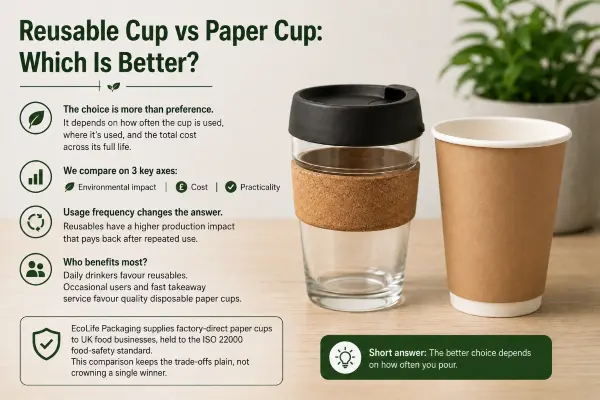
The choice between a reusable cup and a disposable paper cup rarely settles on preference. It settles on how often the cup is used, where it is used, and what each option costs across its full life.
This guide compares the two on three measured axes: environmental impact, cost, and day-to-day practicality, set against current UK rules and figures. A reusable cup carries a heavier production footprint that only pays back after repeated use, so the honest answer shifts with usage frequency.
Daily drinkers tend to favour reusables, while occasional users and fast takeaway service tend to favour quality disposable paper cups. EcoLife Packaging supplies factory-direct paper cups to UK food businesses, held to the ISO 22000 food-safety standard, and this comparison keeps the trade-offs plain rather than crowning a single winner. The short answer, keyed to how often you pour, comes next.
Reusable or Disposable? The Short Answer by Usage Frequency
A reusable cup repays its heavier production only after repeated use, so how often you use it decides the winner. Daily drinkers gain from a reusable cup; occasional users and high-throughput takeaway service gain from quality disposable paper cups.
The pivot is the break-even point, the number of uses at which the two options carry equal carbon impact. Read the three cases below against your own routine.
Reusable or Disposable? The Short Answer by Usage Frequency
A reusable cup repays its heavier production only after repeated use, so how often you use it decides the winner. Daily drinkers gain from a reusable cup; occasional users and high-throughput takeaway service gain from quality disposable paper cups.
The pivot is the break-even point, the number of uses at which the two options carry equal carbon impact. Read the three cases below against your own routine.
- Daily user: a reusable cup passes its break-even within weeks, then lowers impact per drink.
- Occasional user: a reusable cup used below its break-even can carry more impact than the disposables it replaced.
- High-throughput business: quality disposable paper cups keep service moving where washing capacity runs short.
What Separates a Reusable Cup from a Disposable Paper Cup?
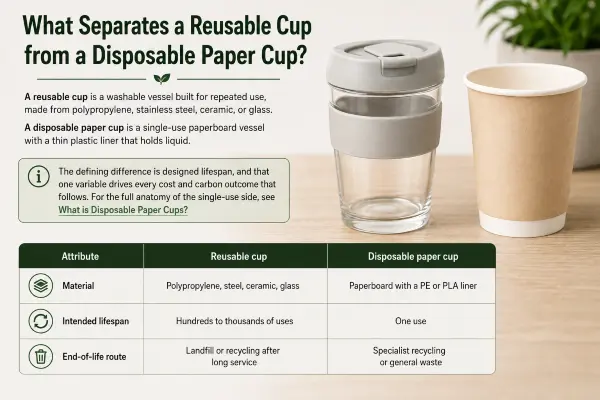
A reusable cup is a washable vessel built for repeated use, made from polypropylene, stainless steel, ceramic, or glass. A disposable paper cup is a single-use paperboard vessel with a thin plastic liner that holds liquid.
The defining difference is designed lifespan, and that one variable drives every cost and carbon outcome that follows. For the full anatomy of the single-use side, see What is Disposable Paper Cups?.
| Attribute | Reusable cup | Disposable paper cup |
| Material | Polypropylene, steel, ceramic, glass | Paperboard with a PE or PLA liner |
| Intended lifespan | Hundreds to thousands of uses | One use |
| End-of-life route | Landfill or recycling after long service | Specialist recycling or general waste |
What Counts as a Reusable Cup?
Reusable cups differ by material, and material sets the up-front carbon debt each one must repay. Lighter polypropylene carries a smaller debt; heavier ceramic, glass, and stainless steel carry a larger one that needs more uses to clear.
- Polypropylene: light, low-cost, roughly one to three years of use, the smallest up-front footprint.
- Glass and borosilicate: heavier and breakable, with a moderate up-front footprint.
- Stainless steel: durable and insulating, with a large up-front footprint repaid over long service.
- Ceramic: heavy and breakable, suited to dine-in rather than transport.
What Is a Disposable Paper Cup?
A disposable paper cup is a paperboard body lined with a thin layer of polyethylene (PE) or polylactic acid (PLA) that resists liquid. Wall construction sets its use case, and the liner is the reason plain paper recycling does not apply.
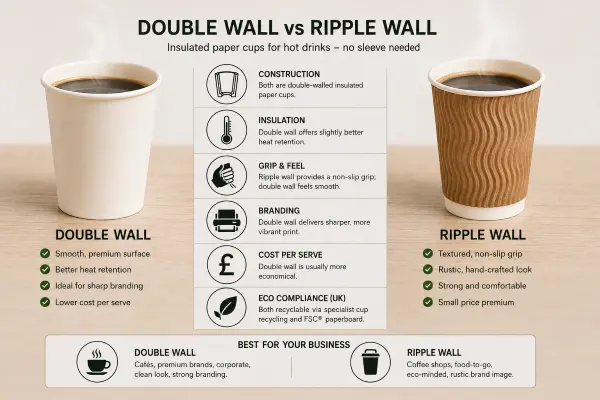
- Single wall: one layer, suited to cold drinks and short-hold hot drinks.
- Double wall: two bonded layers, added insulation for hot drinks.
- Ripple wall: a fluted outer layer, the strongest insulation and grip.
Liner choice matters as much as wall type, since the trade-offs between PLA vs PE Lining shape both the recycling route and the unit cost.
How Do the Two Compare on Environmental Impact?
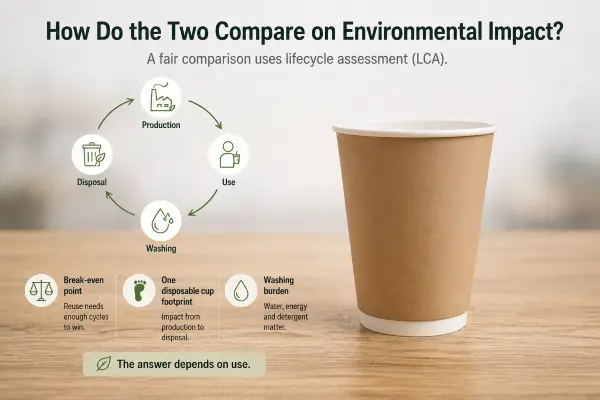
A fair comparison uses lifecycle assessment (LCA), which counts production, use, washing, and disposal rather than a single stage. Read only the disposal stage and a reusable cup looks greener at once; count production and washing and the answer depends on use.
Three measurable variables decide it: the break-even point, the footprint of one disposable cup, and the burden of washing. For how single-use cups shape the wider picture, see Effect of Paper Cups on the Environment.
What Is the Break-Even Point for a Reusable Cup?
A reusable polypropylene cup reaches carbon break-even against a plastic-lined paper cup after roughly 10 to 41 uses, per Zero Waste Scotland’s review of three lifecycle studies. Ceramic and stainless steel begin with a larger footprint and often need well over 100 uses to level out.
Break-even means the point where the cumulative carbon impact of the two options is equal. Below it, the reusable cup is still working off the energy and materials spent in its manufacture; above it, every further use widens its lead over single-use.
| Material | Break-even range | Basis |
| Polypropylene | About 10 to 41 uses | Zero Waste Scotland LCA review |
| Ceramic / stainless steel | 100+ uses | Life-cycle assessment literature |
What Is the Carbon Footprint of a Single Disposable Paper Cup?
A single-use plastic-lined paper cup carries roughly 10 to 30g CO2e, per Zero Waste Scotland. The wide spread reflects material sourcing and the end-of-life route.
Landfill, incineration, and specialist recycling each shift the figure, so no single number fits every cup. That range is what lets you compute your own break-even against a chosen reusable.
Do Washing and Water Use Change the Balance?
Each wash adds water and heating energy, so a reusable cup cleaned inefficiently repays its footprint more slowly. A cup rinsed under a running hot tap costs more per use than one run in a full, efficient dishwasher load.
Commercial settings concentrate this cost, which is why washing capacity belongs in any reusable calculation. A busy café that hand-rinses cups between customers can push the break-even higher than the study figures assume.
Water heating, not the water itself, carries most of the washing footprint, so an efficient dishwasher run at full load is the cheaper path per cup. Carbon is one axis; cost is the axis that decides most business purchasing.
How Do Reusable and Disposable Cups Compare on Cost?
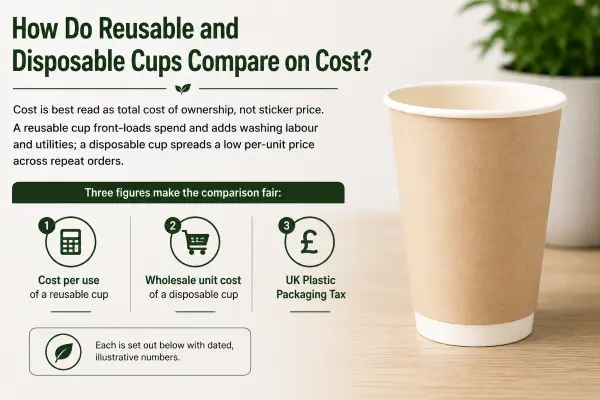
Cost is best read as total cost of ownership, not sticker price. A reusable cup front-loads spend and adds washing labour and utilities; a disposable cup spreads a low per-unit price across repeat orders.
Three figures make the comparison fair: the cost per use of a reusable cup, the wholesale unit cost of a disposable, and the UK Plastic Packaging Tax. Each is set out below with dated, illustrative numbers.
What Is the True Cost Per Use of a Reusable Cup?
Cost per use equals purchase price divided by realistic lifespan, plus a small washing allowance. A £6 reusable cup used 300 times costs about 2p per use before washing; the same cup broken at use 30 costs about 20p per use.
Sustained daily use is the condition that turns a reusable cup into the cheaper option. Breakage resets the sum, so the saving is conditional rather than guaranteed.
| Scenario | Price | Uses | Cost per use (pre-wash) |
| Sustained daily use | £6 | 300 | About 2p |
| Early breakage | £6 | 30 | About 20p |
What Does a Disposable Paper Cup Cost Per Unit at Wholesale?
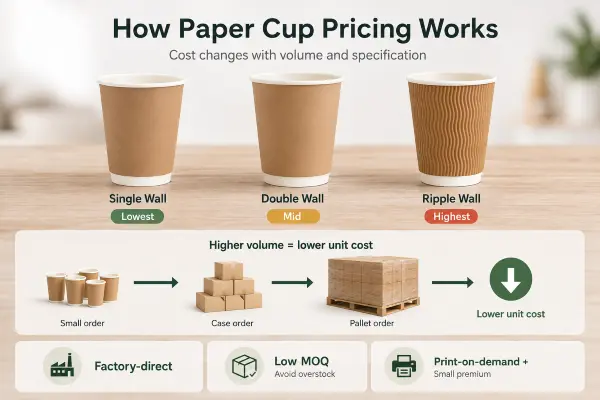
A disposable paper cup’s per-unit cost falls as order volume rises and varies by wall type, with single wall cheapest and ripple wall dearest. Factory-direct sourcing removes the wholesaler mark-up, and a low minimum order quantity keeps small businesses from overstocking.
Prices move with volume and specification, so any single figure stays indicative rather than fixed. A café ordering a few thousand cups a month pays a different unit rate from a multi-site chain buying by the pallet, and print-on-demand branding adds a modest premium.
For live pricing by size and volume, see Cost Per Paper Cup and Wholesale Paper Cups UK.
How Does the UK Plastic Packaging Tax Affect Cup Costs?
The UK Plastic Packaging Tax applies to plastic packaging components with less than 30% recycled content and is charged per tonne, so plastic cups and the plastic liners in paper cups can fall within scope. The rate is £228.82 per tonne from 1 April 2026, per GOV.UK.
The charge feeds into the price of affected stock rather than appearing as a separate line. For a fuller breakdown, see UK Plastic Packaging Tax Explained and the cost view in Plastic Cups vs Paper Cups (Cost & Tax).
Which Option Wins on Hygiene, Convenience and Service Speed?
| Factor | Reusable cup | Disposable paper cup |
| Hygiene control | Depends on wash quality | Fresh sealed unit each time |
| Storage | Needs racking and drying space | Stacks compactly |
| Service speed | Limited by the wash cycle | No wash bottleneck |
| Portability | Heavier, carried back | Light, discarded after use |
Disposables remove the wash bottleneck at peak trade and give a fresh unit for every order. Reusables lower per-drink impact once past break-even but demand storage, drying, and sanitation capacity.
Neither option leads on every factor, so the setting decides which trade-off is worth accepting
Which Cup Suits Your Setting: Café, Takeaway, Event or Home?
| Setting | Recommended | Reason |
| Dine-in café | Reusable | High reuse count clears break-even; no transport |
| High-volume takeaway | Disposable paper cups | Wash capacity is the limit at peak service |
| Large event | Disposable | Logistics favour single-use at scale |
| Regular home use | One reusable | Daily use passes break-even quickly |
Each recommendation follows the earlier cost and carbon logic rather than preference. A venue’s split between dine-in and takeaway is the strongest single signal for which way to lean.
How Can UK Businesses Lower Cup Impact Without Sacrificing Service?
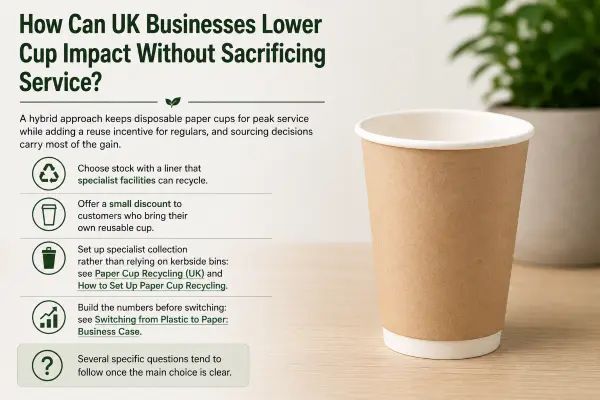
A UK business rarely has to pick one model outright. A hybrid approach keeps disposable paper cups for peak service while adding a reuse incentive for regulars, and sourcing decisions carry most of the gain.
- Choose stock with a liner that specialist facilities can recycle.
- Offer a small discount to customers who bring their own reusable cup.
- Set up specialist collection rather than relying on kerbside bins: see Paper Cup Recycling (UK).
Several specific questions tend to follow once the main choice is clear.
Are Reusable Cups Always Better for the Environment?
Not always. A reusable cup used below its break-even point can carry a higher footprint than the disposables it would have replaced. The advantage is conditional on reaching, then passing, the material’s break-even threshold.
What Are the Main Disadvantages of Reusable Cups?
Reusable cups carry recurring drawbacks that a purchase price hides:
- Up-front capital outlay before any saving begins.
- Washing labour, water, and energy at every use.
- Cross-contamination risk when cleaning is inconsistent.
- Storage and drying space in busy sites.
- Breakage, which resets the cost-per-use sum.
Can Disposable Paper Cups Be Recycled in the UK?
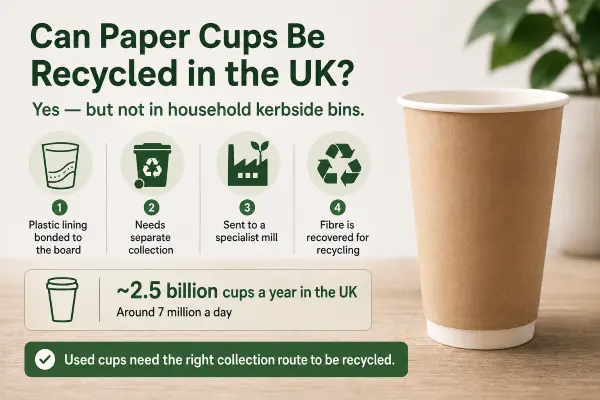
Disposable paper cups can be recycled in the UK, but only through specialist facilities that separate the plastic liner from the paperboard, not standard kerbside collection. Dedicated cup collection schemes route used cups to those facilities.
Reusable or Disposable: Which Is Right for a Coffee Shop?
A coffee shop’s answer depends on its takeaway ratio. Takeaway-led venues lean on quality disposable paper cups, often with a small reuse discount, while dine-in-led venues can run reusables for seated customers.
Custom-printed disposables also carry brand value that a customer’s own reusable cup cannot. See Best Paper Cups for Coffee Shops for stock suited to high throughput.
Disposable Convenience or Reusable Commitment: Making the Responsible Choice
The responsible choice is the one matched to frequency and setting, not a blanket rule. A reusable cup rewards daily, single-user habits once it clears its break-even; quality disposable paper cups keep fast, high-volume service running where washing capacity is short.
Cost follows the same logic: reusables win on sustained personal use, disposables win on volume and speed, and the UK Plastic Packaging Tax nudges recycled-content and paper choices for both. Match the cup to how often it pours and where it serves, and the decision resolves itself.
Weigh your takeaway ratio and wash capacity first; the right cup follows from those two numbers. EcoLife Packaging supplies factory-direct paper cups to UK businesses that choose disposables, held to the ISO 22000 food-safety standard, with liners that specialist facilities can recycle.